

If you have been quoted $1,000 or more a month just to start with NetSuite, you are not alone. Most small business owners hit the same wall the moment they ask for a quote.
NetSuite is a serious ERP platform. The problem is it was not built for businesses like yours. It was built for mid-market companies with 50-plus users, multi-entity reporting, and the kind of budget that comes with a finance team in place.
The pricing is not transparent. The implementation often takes 4 to 6 months. And once you are inside, you are paying for features you will probably never use.
So you start searching for a NetSuite alternative. And the first thing you notice is that most of the lists out there compare NetSuite to other enterprise platforms like SAP, Oracle, and Microsoft Dynamics. None of those are actually better for a small business. They are just different versions of the same problem.
This post is different. Here are 7 NetSuite alternatives that actually fit a small business budget and timeline, with honest pros and cons of each one.
So, let’s jump into the details!
Why Small Businesses Look for a NetSuite Alternative
Before getting to the list, it helps to be clear on why people search for this in the first place. From conversations with small business owners and from what shows up in NetSuite reviews, the reasons are pretty consistent:
- Pricing starts around $999 a month plus per-user fees, with most small businesses landing well above that
- There is usually a 10-user minimum on NetSuite contracts, so even a 5-person team pays for 10 seats
- Implementation typically runs $25,000 to $100,000 depending on complexity
- The learning curve is steep for non-technical owners and operators
- Feature overload is real. Most small businesses use less than 30% of what NetSuite offers
- You usually need a value-added reseller (VAR) to set it up, which adds another layer of cost
Add all of that up and the math stops working below a certain business size. If your team is under 50 people and you are not running complex global inventory, NetSuite is almost always overkill.
What to Look for in a NetSuite Alternative

Not every NetSuite alternative is a good fit for a small business. Some are just smaller enterprise tools with the same problems at a slightly lower price. Before you start comparing options, get clear on what actually matters.
a) Transparent Pricing
If you have to “request a quote” to find out what something costs, that is a flag. Small businesses need predictable monthly costs. Look for tools that publish their pricing on the website, with clear per-user or per-feature breakdowns.
b) Fast Setup Without Consultants
The whole point of leaving NetSuite is to avoid 6-month implementations. Pick a tool you can set up yourself, or with minimal outside help, in days or weeks.
c) Coverage of Core Modules (HR, CRM, Accounting)
A real ERP alternative needs to cover the basics. HR for managing employees. CRM for tracking sales and customers.
Accounting for invoicing, expenses, and financial reporting. If a tool only covers one of these, you are going to end up stitching together multiple subscriptions, which is the exact problem you were trying to solve.
d) Data Ownership and Self-Hosting Options
Cloud-only tools mean your business data lives on someone else’s server. For some companies that is fine. For others, especially those handling sensitive customer or financial data, self-hosted options are worth considering.
e) Easy Integration with Existing Tools
Your business probably already runs on something. WordPress, WooCommerce, Stripe, Mailchimp, Slack. The right NetSuite alternative should integrate with the tools you already use, not force you to rebuild your entire stack.
7 Best NetSuite Alternatives for Small Businesses in 2026
Here are the 7 best NetSuite alternatives for small businesses, ranked by how well they fit small business needs (not by feature breadth, which is a different game entirely).
1. WP ERP – Best NetSuite Alternative for WordPress Users
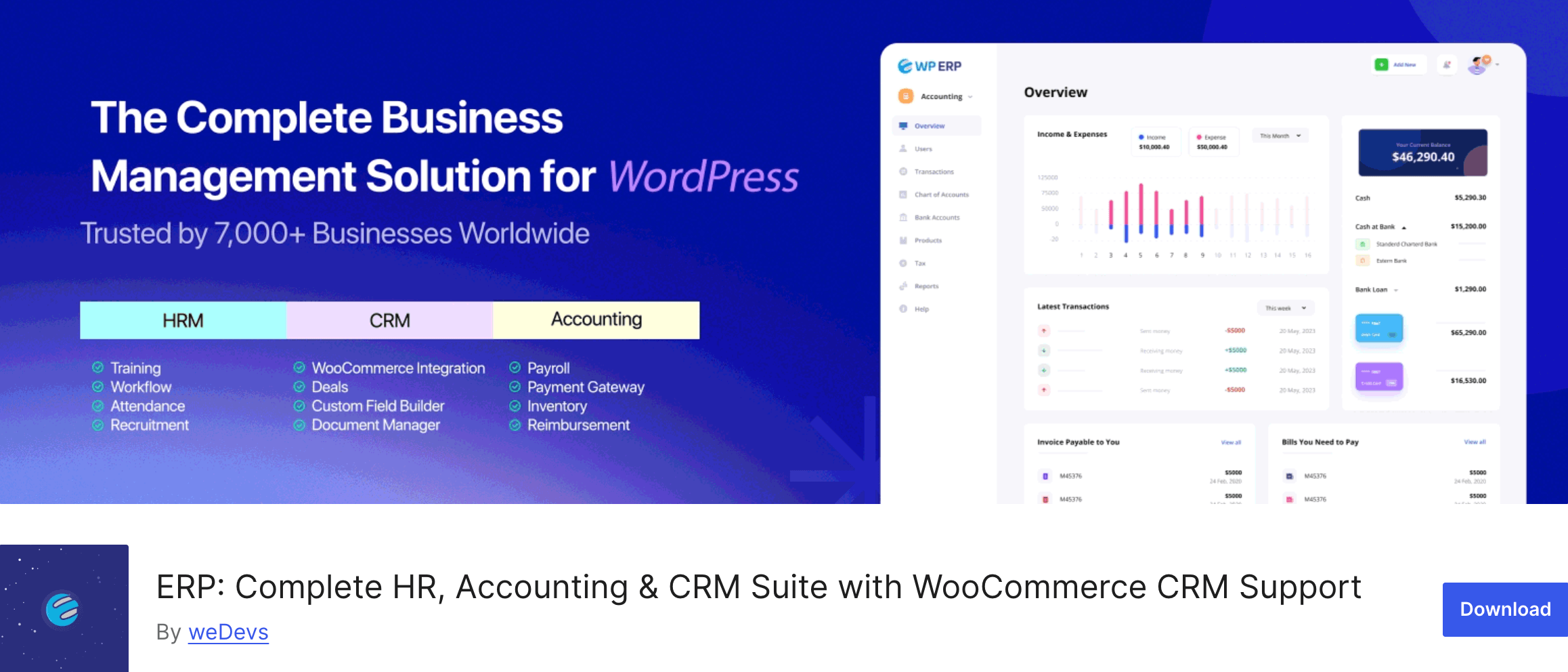
Best for: WordPress users running small businesses who want HR, CRM, and accounting in one self-hosted dashboard.
Pricing: Free core plan + Pro from $9.99 a month + $3 per user.
Standout features: All-in-one HRM, CRM, and Accounting modules built directly into WordPress. Native WooCommerce sync for customers and orders. 20+ extensions for payroll, recruitment, attendance, deals, and more. Self-hosted on your own server.
Pros:
- Free core version covers all three modules with no user limits
- Lives inside your WordPress dashboard, so there is one less platform to log into
- Self-hosted means your data stays on your server, not someone else’s cloud
- Pricing is fully transparent and predictable. No surprise enterprise quotes.
- 14-day money-back guarantee on Pro plans
Cons:
- Built for businesses with under 200 employees. Larger teams will outgrow it.
- Frontend access is limited to HR. Accounting and CRM staff need backend access.
- Inventory and manufacturing features are lighter than NetSuite’s
Why it is a NetSuite alternative: WP ERP solves the same core problem NetSuite does (consolidating HR, CRM, and accounting into one system) but at a fraction of the cost and without the per-user enterprise pricing model.
For any small business already running on WordPress, it is the most natural fit because there is nothing new to learn or host.
2. Odoo – Best Open-Source NetSuite Alternative

Best for: Odoo is best for small to mid-sized businesses that want a fully customizable open-source platform and have technical resources to support it.
Pricing: One App Free plan available. Standard plan starts at $24.90 per user per month.
Standout features: Modular architecture with apps for accounting, CRM, HR, inventory, manufacturing, and more. Strong community edition. Active developer community.
Pros:
- Genuinely open source with a strong community
- Modular setup, so you only enable what you use
- Covers nearly every business function under one platform
Cons:
- The “free” Community edition requires hosting, maintenance, and developer time, which adds up
- Steep learning curve for non-technical owners
- Per-user pricing on the paid plans climbs fast as you grow
If you want a deeper look at how Odoo stacks up, we wrote a full breakdown of the best Odoo alternatives for small businesses.
3. Zoho One – Best NetSuite Alternative for All-in-One SaaS
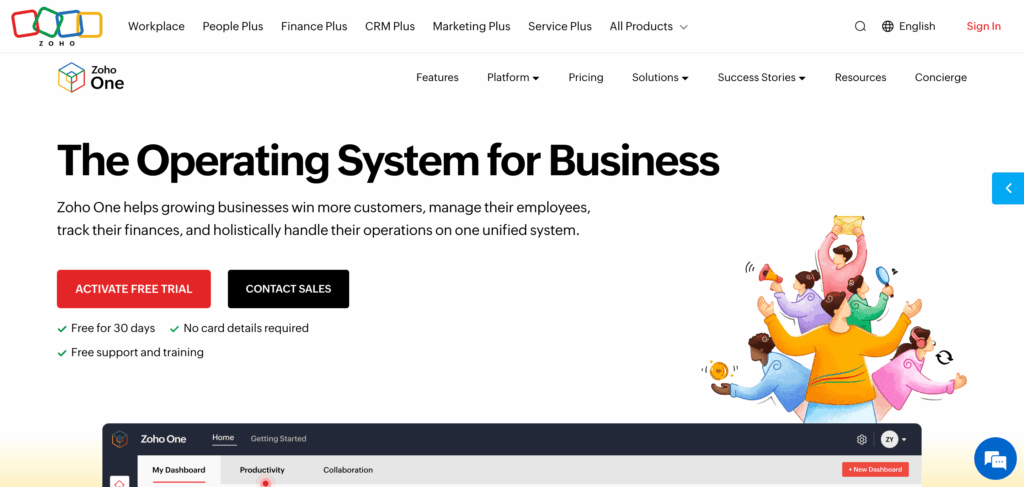
Best for: Zoho One is best for small businesses already using Zoho products who want to consolidate into one ecosystem.
Pricing: Around $37 per user per month (annual billing).
Standout features: Bundles 40+ Zoho apps including CRM, Books (accounting), People (HR), Projects, Mail, and more. Strong if you already live in the Zoho ecosystem.
Pros:
- One subscription covers a wide range of business needs
- Apps are reasonably well integrated with each other
- Solid mobile apps across the suite
Cons:
- Per-user pricing scales aggressively as your team grows
- Quality varies between apps. Some are great, some feel underbuilt.
- Cloud-only. No self-hosting option.
4. Acumatica – Best for Growing Businesses Approaching Mid-Market
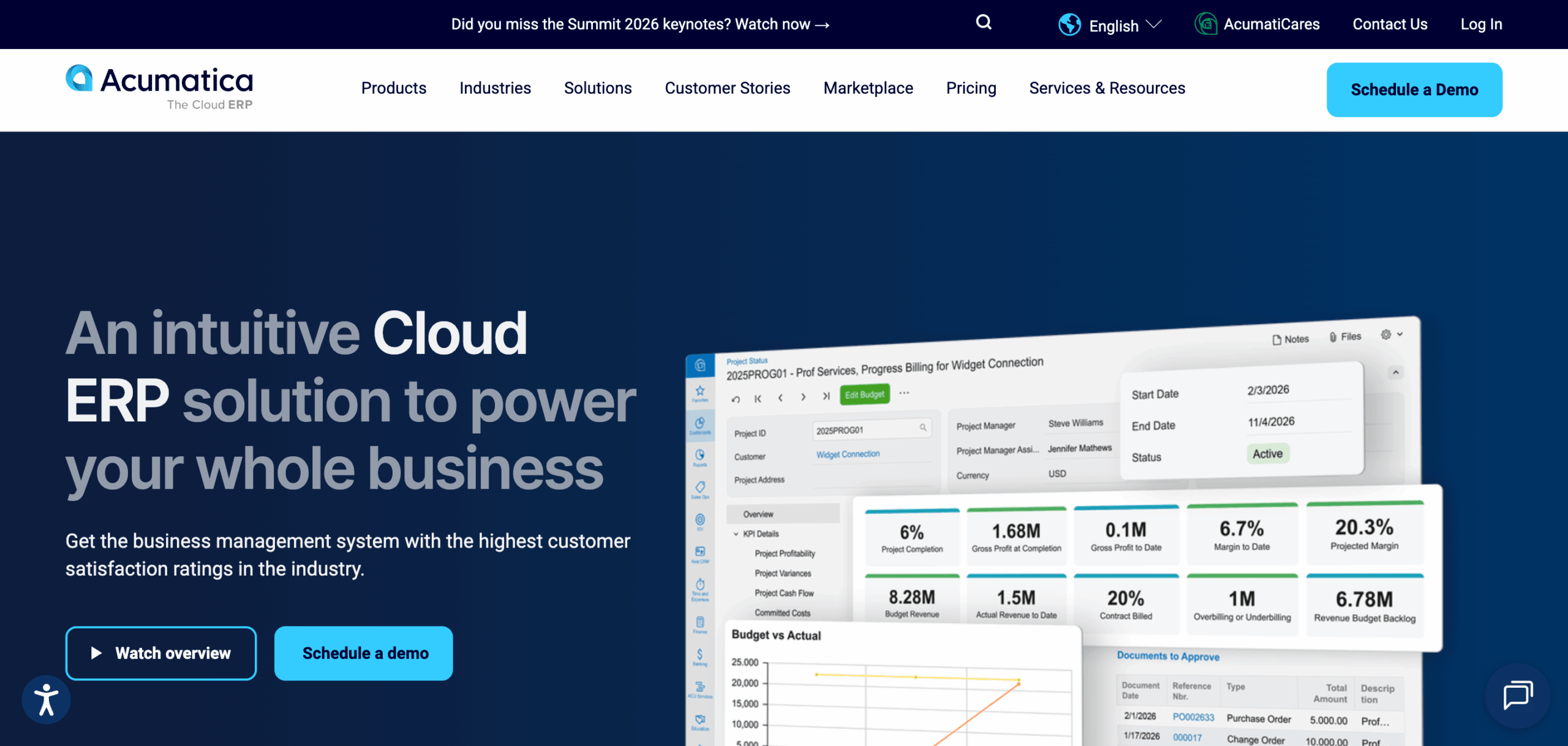
Best for: Acumatica is best for companies in the $5M to $50M revenue range that need real ERP functionality but want to avoid NetSuite’s per-user pricing.
Pricing: Custom pricing, typically $1,000 to $3,000 a month plus implementation costs.
Standout features: Consumption-based licensing instead of per-user. Strong financials, distribution, and manufacturing modules. Cloud and on-premise deployment options.
Pros:
- Unlimited users at a flat platform cost
- Genuinely deep ERP functionality
- Flexible deployment options
Cons:
- Still expensive for true small businesses
- Implementation usually requires a partner ($25K to $100K)
- Smaller partner ecosystem than NetSuite
Acumatica is honestly more of a NetSuite competitor than a small business alternative. If you are under 25 employees, it is probably not the right fit.
5. Sage Intacct – Best for Finance-Heavy Small Businesses
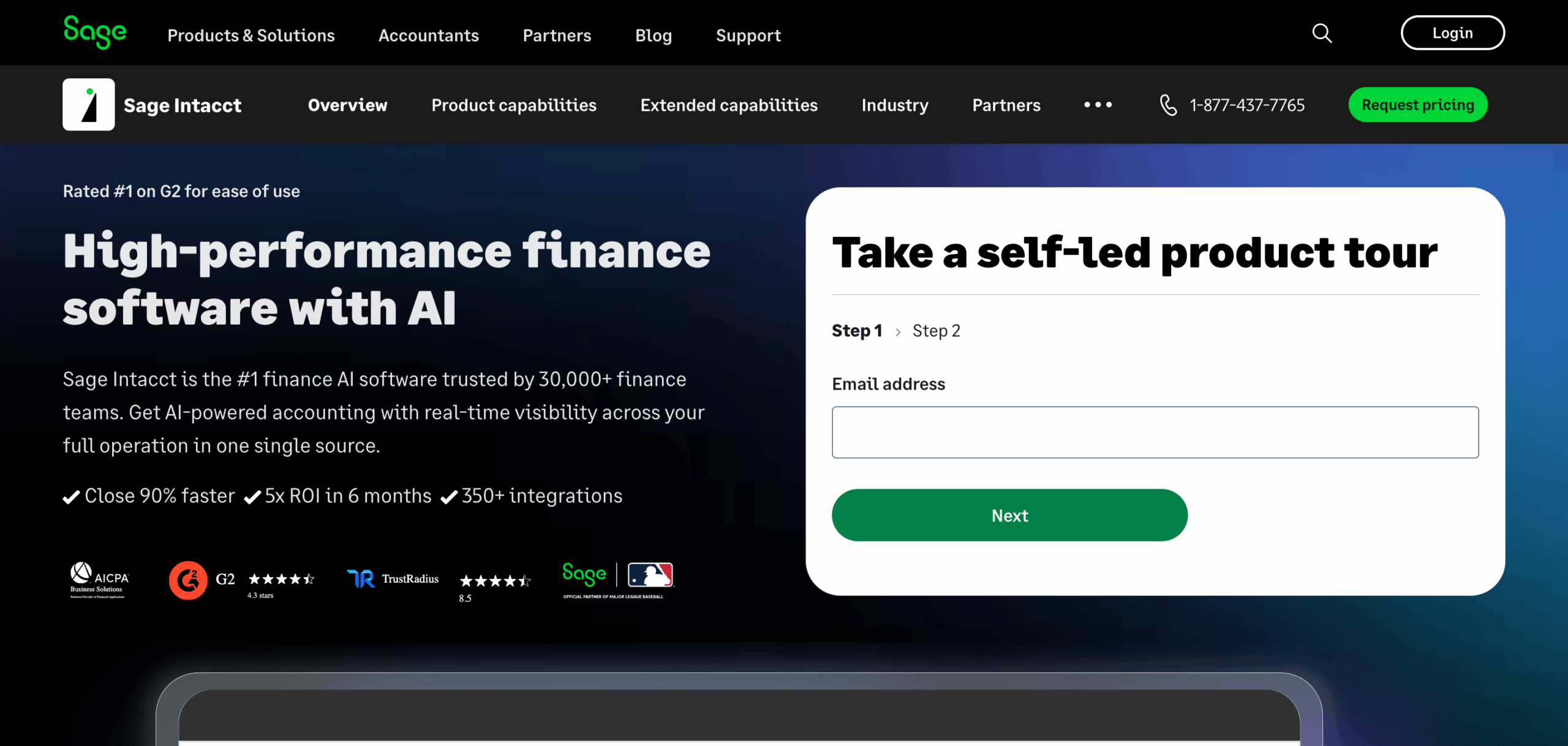
Best for: Sage Intacct is best for service businesses, nonprofits, and professional firms where financial reporting and multi-entity consolidation are the main needs.
Pricing: Roughly $400 to $600 per user per month, plus implementation.
Standout features: Best-in-class financial reporting. Multi-entity consolidation. Strong dimensional reporting for service-based businesses.
Pros:
- Excellent financial reporting and consolidation
- Built specifically for finance teams
- Handles multi-entity well, even at smaller scales
Cons:
- It is a financial system, not a true ERP. Inventory and operations are weak.
- No real CRM or HR functionality
- Pricing is high once you add multiple users
If your business is mostly about managing money rather than moving products, Intacct is worth a look. For everyone else, it leaves too many gaps.
6. SAP Business One – Best for Manufacturing-Focused SMBs
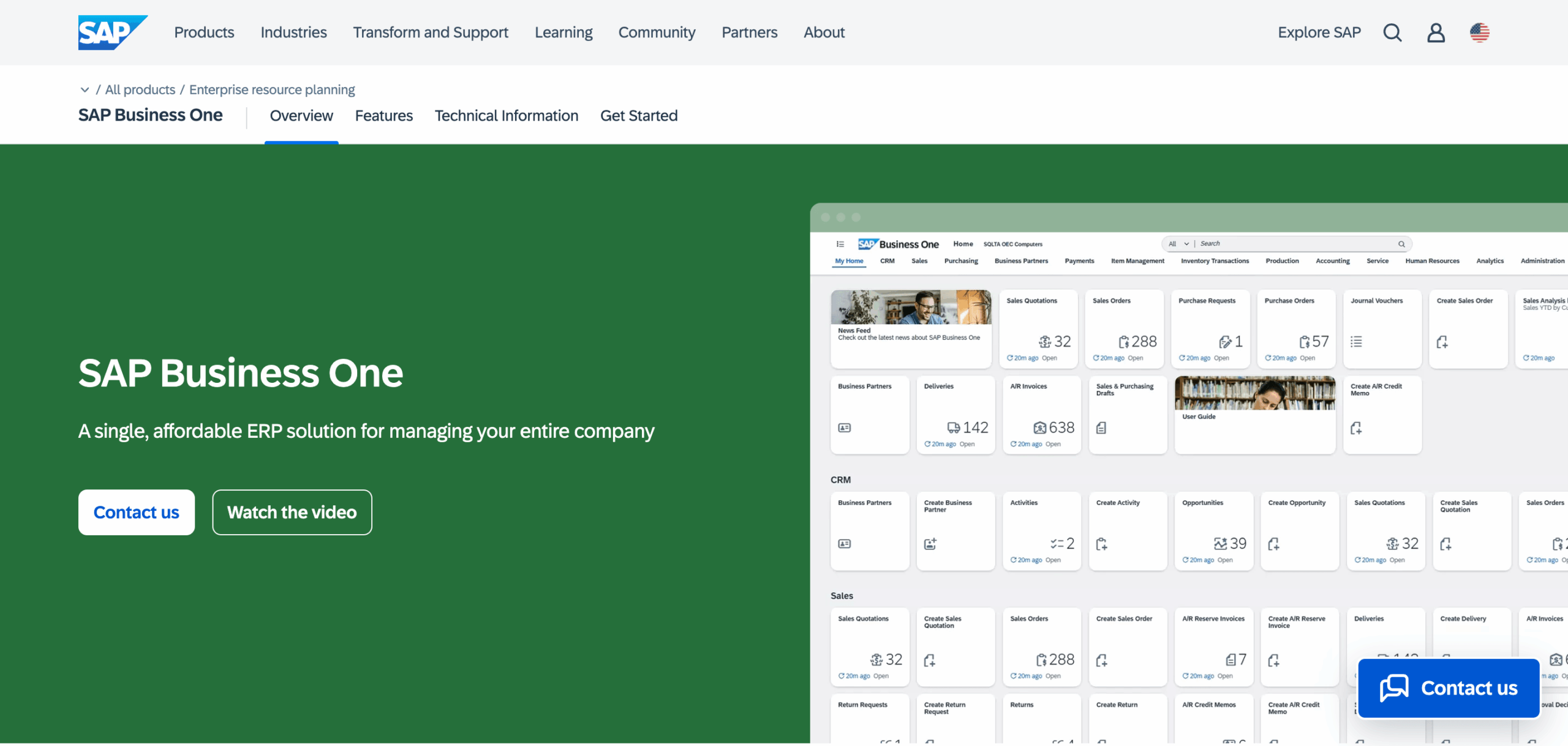
Best for: SAP Business One is best for small to mid-sized manufacturing or distribution companies that need real production planning and inventory control.
Pricing: Around $108 per user per month for the Professional license, plus implementation costs.
Standout features: Decades of SAP manufacturing pedigree at a smaller-business price point. Strong MRP, inventory, and production planning.
Pros:
- Genuinely capable for manufacturing and distribution workflows
- Established product with a long track record
- On-premise and cloud options
Cons:
- Implementation is complex and usually requires a partner
- Overkill for service-based businesses
- User interface feels dated compared to newer cloud ERPs
7. QuickBooks – Best for Businesses That Don’t Need True ERP
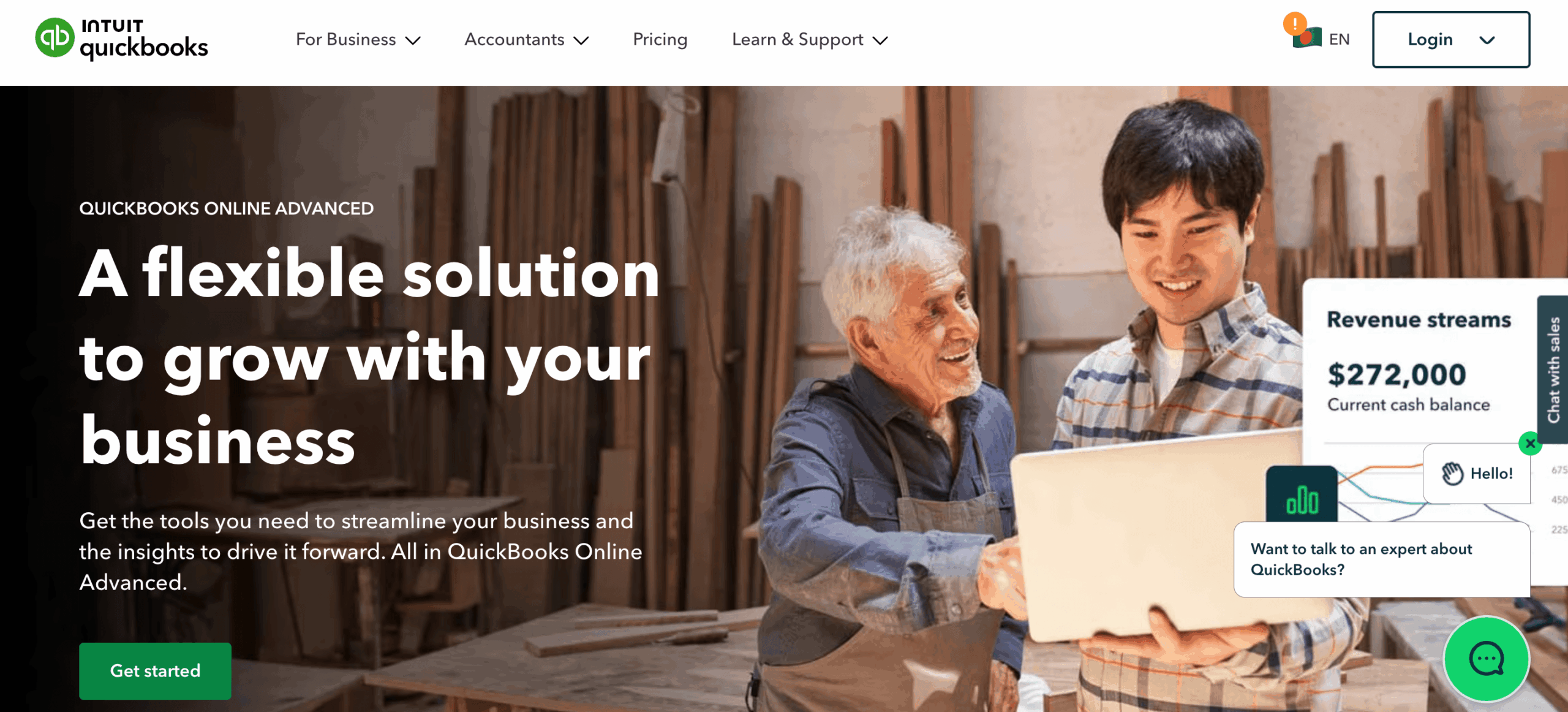
Best for: Very small businesses (under 10 employees) that just need accounting and a basic CRM.
Pricing: QuickBooks Online from $35 a month. HubSpot CRM has a free tier; paid plans start around $20 per user per month.
Standout features: This is what most small businesses actually run on. QuickBooks handles invoicing, expenses, and basic accounting. HubSpot handles contacts and sales pipeline.
Pros:
- Both tools are easy to set up and use
- Strong app ecosystems
- Predictable monthly costs
Cons:
- No HR module. You will need a third tool for that.
- Manual data sync between QuickBooks and HubSpot
- Two subscriptions instead of one, which adds up fast as you grow
This is not really a NetSuite alternative in the technical sense. It is what people use when they realize they do not need an ERP at all. For very early-stage businesses, that is often the right answer.
NetSuite Alternative Comparison Table
| Tool | Best for | Starting price | HR | CRM | Accounting | Self-hosted | WordPress-native |
|---|---|---|---|---|---|---|---|
| WP ERP | WordPress small businesses | Free / $9.99/mo | ✅ | ✅ | ✅ | ✅ | ✅ |
| Odoo | Open-source customization | Free / $24.90/user/mo | ✅ | ✅ | ✅ | ✅ | ❌ |
| Zoho One | Zoho ecosystem users | $37/user/mo | ✅ | ✅ | ✅ | ❌ | ❌ |
| Acumatica | Growing mid-market | $1,000-3,000/mo | ✅ | ✅ | ✅ | ✅ | ❌ |
| Sage Intacct | Finance-heavy SMBs | $400-600/user/mo | ❌ | ❌ | ✅ | ❌ | ❌ |
| SAP Business One | Manufacturing SMBs | ~$108/user/mo | ✅ | ✅ | ✅ | ✅ | ❌ |
| QuickBooks + HubSpot | Very small teams | $35 + $20/user/mo | ❌ | ✅ | ✅ | ❌ | ❌ |
Which NetSuite Alternative Should You Choose?
Picking the right tool depends less on features and more on your specific situation. Here is a simple decision framework:
- If you run on WordPress and want everything in one dashboard: WP ERP is the closest fit. Nothing else is WordPress-native at this level.
- If you want fully open source and have technical resources: Odoo Community edition gives you the most flexibility, but you will need developer support.
- If you are already in the Zoho ecosystem: Zoho One makes sense for the bundle pricing.
- If you are approaching $10M+ revenue and outgrowing SMB tools: Acumatica is a serious contender.
- If financial reporting is your main need: Sage Intacct does that one job better than anyone.
- If you are in manufacturing or distribution: SAP Business One has the deepest functionality.
- If you only need basic finance and CRM: QuickBooks + HubSpot is probably enough.
For most WordPress-based small businesses, the choice comes down to WP ERP or Odoo. WP ERP is faster to set up and lives inside the platform you already use. Odoo offers more depth but takes more time and technical effort to run.
Why WP ERP Is the Best NetSuite Alternative for WordPress-Based Small Businesses
If your business already runs on WordPress, WP ERP is honestly hard to beat. It solves the same core problem NetSuite does (one system for HR, CRM, and accounting) without the price tag, the per-user pricing model, or the 6-month implementation.
Here is what you actually get:
- One dashboard for HR, CRM, and Accounting. Not three subscriptions, not three logins. Everything inside your existing WordPress admin.
- No per-user enterprise pricing. Pro starts at $9.99 a month plus $3 per user. You see the price before you click.
- Self-hosted by design. Your employee data, customer records, and financials stay on your own server. Not someone else’s cloud.
- Free core version with no user limits. You can run the entire HR, CRM, and Accounting modules for free, forever, with no time bombs.
- 14-day money-back guarantee on Pro plans, so the risk is genuinely low.
- 10,000+ businesses across 160+ countries already use it.
- WordPress-native. It lives where your business already runs, which means no new platform to learn or host.
The honest tradeoff is that WP ERP is built for small to mid-sized businesses, not enterprises. If you have 200+ employees or you need NetSuite-level multi-subsidiary consolidation, you will outgrow it. But for small businesses, that is exactly the point.
Frequently Asked Questions
Is there a free alternative to NetSuite?
Yes. WP ERP offers a fully free core plan that covers HR, CRM, and Accounting for unlimited users. Odoo also has a free Community edition, though it requires self-hosting and technical setup. Both are real ERP alternatives, but WP ERP is faster to deploy if your business already runs on WordPress.
What is the best NetSuite alternative for small business?
For most small businesses under 50 employees, the best NetSuite alternative depends on your stack. WP ERP is the strongest fit for WordPress users. Odoo works if you have technical resources. Zoho One is a good pick for businesses already in the Zoho ecosystem. Avoid enterprise tools like SAP or Oracle unless you are genuinely mid-market.
How much does NetSuite cost for small business?
NetSuite pricing typically starts around $999 a month for the platform license, plus around $99 per user per month, with a 10-user minimum. Implementation usually adds $25,000 to $100,000 in upfront cost. Most small businesses end up paying $1,500 to $3,000 a month once everything is factored in.
Can WordPress replace NetSuite?
For small businesses, yes. WP ERP turns WordPress into a functional ERP system with HR, CRM, and Accounting modules built in. It will not replace NetSuite for businesses with complex multi-subsidiary global operations, but for small businesses it covers the same core needs at a fraction of the cost.
Is Odoo a good NetSuite alternative?
Odoo is one of the most capable open-source NetSuite alternatives. The Community edition is free and the modular setup is flexible. The catch is that running Odoo well takes technical resources, hosting, and ongoing maintenance. For small businesses without a developer on hand, that overhead can offset the cost savings.
What is the cheapest ERP for small business?
WP ERP is among the cheapest real ERP options for small businesses. The core plan is free with no user limits, and Pro starts at $9.99 a month plus $3 per user. Odoo Community edition is also free but adds hosting and maintenance costs. QuickBooks + HubSpot is cheaper but is not actually a full ERP.
Let’s Wrap it up!
NetSuite is a powerful platform. It is just not built for small businesses. The pricing model, the implementation timeline, and the feature depth all point to a different kind of buyer.
The good news is the small business ERP market has caught up. There are now serious NetSuite alternatives across every category. Open source, all-in-one SaaS, finance-focused, manufacturing-focused, and WordPress-native.
The right NetSuite alternative depends on your stack, your team size, and what you actually need to run. For most WordPress-based small businesses, WP ERP is the closest fit. Free to start, no per-user surprises, and everything in one dashboard.
If you are still weighing options, book a free 30-minute call and I am happy to help you figure out whether WP ERP is the right move for your business. No sales pitch, just clarity.